A pressure-relief manifold is a small component with a defined safety job in Bubble CPAP. It limits the pressure that can build in the circuit when gas keeps flowing, but the path to the water seal is obstructed. Neonatal and infant lungs tolerate little excess pressure, and this therapy relies on continuous flow and a column of water to set the pressure level. This article explains what the device does, the research behind its use, the specifications of the B&B Bubbler 12.5 cm H2O Pressure Relief Manifold, and the checks that keep it dependable at the bedside.
What Does a Pressure-Relief Manifold Do in a Bubble CPAP Circuit?
A pressure-relief manifold is a pressure limitation device placed in a Bubble CPAP circuit. Its internal valve stays closed during normal therapy. When circuit pressure climbs above the valve’s rated threshold, the valve opens and vents gas, then closes again once pressure returns to a safe level. Medical device nomenclature describes this category of valve as a component that regulates the maximum pressure in a gas circuit and opens automatically to prevent excess pressure from damaging the patient or connected equipment.
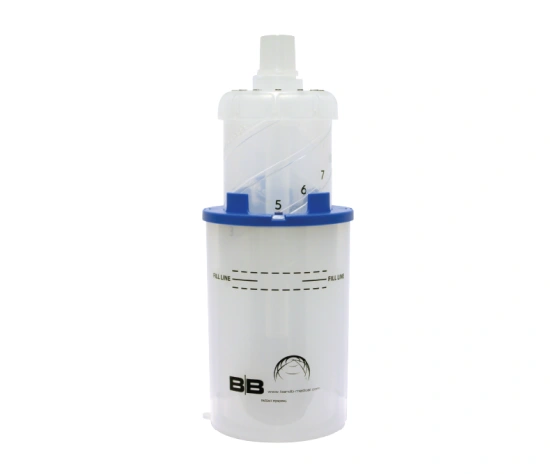
The manifold also serves as a connection point. The B&B model includes a gas supply line for an additional gas source and a capped oxygen sensor port, so a single component covers pressure limitation, gas supply, and oxygen sensing access. The water seal sets the therapeutic pressure, and the manifold defines the ceiling above it.
How a Water Seal Sets Pressure and Where Risk Enters the Circuit
In a bubble CPAP system, humidified bias flow enters the inspiratory limb, and the expiratory limb ends in a water chamber. The depth of submersion sets the pressure, so a tube submerged 5 cm below the surface produces a pressure near 5 cm H2O. Gas escapes by bubbling through the water, and those bubbles create pressure oscillations of roughly 4 cm H2O around the mean. At a 5 cm H2O setting, airway pressure may swing between 3 and 7 cm H2O.
The design is simple and economical, but it depends on an open expiratory path. Gas keeps flowing from the source, whether or not it can leave. A kinked tube, a pocket of fluid, or any blockage between the gas supply and the water chamber pushes circuit pressure above the set level. Authors writing in Respiratory Care observed that many bubble CPAP devices lack the safety features and alarms found on ventilator-derived CPAP systems. A pressure-relief valve closes part of that gap by adding a mechanical upper limit to the circuit.
Condensate in the Expiratory Limb and the Research Behind Pressure Relief
Warm humidified gas cools as it travels through the expiratory limb, and condensate collects in the tubing. Researchers measured what that fluid does to the delivered pressure. With 20 mL of condensate in the exhalation limb, the pressure reaching the patient rose significantly, and the pressure oscillations grew larger. Adding a pressure-relief valve to the circuit attenuated peak tracheal pressure effectively, yet it lowered mean pressure by only 0.5 to 1.5 cm H2O.
Those findings produced practical recommendations. The authors advised continuous pressure monitoring at the nasal interface, an adjustable pressure-relief valve set 5 cm H2O above the desired mean pressure, and emptying fluid from the exhalation limb every 2 to 3 hours. The valve limits dangerous peaks, and diligent circuit maintenance keeps the mean pressure accurate. Humidification remains essential for infant airways, and its benefits are covered in How does heated and humidified air improve CPAP therapy? It is also the reason condensate management belongs in every protocol.
B&B Bubbler 12.5 cm H2O Pressure Relief Manifold Specifications
The B&B Bubbler 12.5 cm H2O Pressure Relief Manifold™ is a single-use component designed for neonatal and pediatric patients. The table summarizes its main specifications.
Feature | Specification |
Relief threshold | Relieves pressure in excess of 12.5 cm H2O |
Patient weight | Less than 10 kg |
Use | Single-use |
Included parts | Pressure relief valve, gas supply line, capped oxygen sensor port |
Inlet | 22 mm ID, compatible with standard humidifier chambers |
Materials | Free of latex and phthalates |
Compatibility | B&B Bubbler Water CPAP Valve 0 to 10 cm H2O and other commercially available systems |
Care areas | Neonatal critical care units, delivery rooms, special procedure units |
Each unit ships ready to integrate into a circuit, which shortens setup and keeps the pressure limitation system consistent from patient to patient.
Fresh Gas Inlet and Oxygen Sensor Port: Added Functions of the Manifold
Neonatal circuits often call for an additional gas source and a way to confirm oxygen delivery. The gas supply line on the manifold lets an additional gas source enter the circuit, and the oxygen sensor port, supplied capped, is designed to accept a sensor when oxygen monitoring is required at that point.
The 22 mm ID inlet connects to all standard humidifier chambers, so the manifold fits the humidification equipment a unit already uses. Latex-free and phthalate-free construction is an important consideration for any device that contacts an infant’s respiratory circuit. Together, these features make the manifold a multi-purpose junction in the circuit, with pressure limitation as its central role.
Where Pressure Relief Manifolds Fit in a Bubble CPAP Setup
Pressure Relief Manifolds are companion components to the water seal valve. B&B Medical introduced its manifold after clinicians requested expanded component options following the launch of the Bubbler. The B&B Bubbler Water Seal CPAP Valve delivers 0 to 10 cm of PEEP to infants under 10 kg, adjusts from 1 to 10 cm H2O with a rotating dial and setting lock, and uses a dual-chambered wall that keeps the fluid level visible and steady during use.
The manifold’s 12.5 cm H2O threshold sits above the Bubbler’s 10 cm H2O maximum setting. That leaves the full adjustable range open for therapy while capping excursions beyond it. The manifold can also be used with other commercially available systems, and the remaining circuit components, including the humidifier, neonatal circuit, CPAP interface, manometer, and blender, are available from multiple manufacturers.
Bedside Checks That Keep Pressure Relief Dependable
A pressure-relief valve protects the patient only when it is seated, intact, and paired with a circuit that is maintained. Common bedside practices include the following.
- Inspect the valve before use to confirm it is seated and undamaged.
- Run a pressure check before connecting the patient, confirming that the circuit reaches and holds the intended pressure.
- Monitor pressure at the patient interface throughout therapy.
- Empty condensate from the exhalation limb every 2 to 3 hours, following the research recommendation.
- Check tubing for kinks and compression, especially after repositioning the infant.
- Replace the manifold according to facility protocol, since it is a single-use device.
Facility protocols and manufacturer instructions define the final schedule, and every clinician using the circuit should know where the valve sits and how to verify it.
Frequently Asked Questions
The manifold relieves pressure in excess of 12.5 cm H2O. Its relief valve is rated at that threshold and vents gas when circuit pressure rises above it.
The two components serve different functions. The water seal sets the CPAP level through the depth of submersion, and the manifold limits pressure above its rated threshold if the circuit becomes obstructed.
The B&B manifold is designed for patients weighing less than 10 kg who need a fresh gas inlet, an oxygen sensor port, and a pressure limitation system. It is used in neonatal critical care units, delivery rooms, and special procedure units.
Warm humidified gas cools in the expiratory limb, and the resulting fluid partially blocks the path of exhaled gas. In measurements with 20 mL of condensate, delivered pressure and pressure oscillations both increased significantly. Researchers recommended emptying the exhalation limb every 2 to 3 hours.
Manufacturer documentation describes it as a single-use device. It is made from materials free of latex and phthalates.
B&B Medical Technologies: Equipping Neonatal and Critical Care Teams Since 1985
For nearly four decades, B&B Medical Technologies has supplied airway and respiratory devices to hospitals from its Carlsbad, California headquarters. Its infant CPAP lineup supports Bubble CPAP with the B&B Bubbler, the Pressure Relief Manifold, the Single Pole Clamp, NEO2-Safe, and the nCPAP Cap. Securement products include the StabilTube, LockTite, ET Tape II, ET Tape, and Baby Tape Plus endotracheal tube holders, along with TrachGuard and TrachStay for tracheostomy tubes. The Universal Bite Block and Bite Proof Bite Block protect endotracheal tubes, the HOPE Nebulizer delivers continuous aerosol therapy, and the test lung range with the Resistor Kit, Wrap-Safe, and Accutach Flow Sensor supports equipment testing and calibration. Each product reflects the same commitment to dependable devices for adult, pediatric, and neonatal patients.