Parents of a premature baby usually ask this question within the first days of NICU life, and the answer is a range. Most premature babies receive bubble CPAP or another form of CPAP for a few weeks. Babies born before 30 weeks often remain on it until they reach 32 to 34 weeks of corrected age, a measure that adds the weeks since birth to the gestational age at birth. Published studies, hospital guidelines, and clinical trial protocols show how neonatal teams decide when a baby is ready to come off. This guide explains the typical timeline, the readiness criteria, the weaning methods, and the factors that make one baby’s course shorter or longer than another’s.
How Long Premature Babies Stay on Bubble CPAP
Time on CPAP varies widely between babies, and published studies show the spread. In a randomized trial of infants born at 32 weeks or earlier, the median total time on nasal CPAP was 14 to 16 days, depending on the weaning strategy. A separate trial of infants born between 26 and 32 weeks recorded averages of 27 to 32 days. A review of preterm infants born before 34 weeks at one Norwegian hospital found a median weaning phase of 20 days, with the youngest babies needing the longest.
These figures describe groups, and individual babies land on either side of them. The youngest and smallest infants, whose lungs have had the least time to mature, consistently need the longest courses. Parents who want background on how the therapy supports breathing without a breathing tube can read How Bubble CPAP is a Non-Invasive Lifeline for Infants.
Gestational Age at Birth Sets the Timeline
Gestational age at birth shapes the length of CPAP, since the youngest babies start with the least mature lungs. Some units plan around a corrected-age target, and a multicenter trial protocol for babies born before 30 weeks illustrates the approach.
Gestational Age at Birth | CPAP Target in the Trial Protocol |
Under 28 weeks | Continue CPAP until at least 34 weeks of corrected age |
28 to 30 weeks | Continue CPAP until at least 32 weeks of corrected age |
The rationale comes from outcome data. Neonatal units that delay CPAP weaning until 32 to 34 weeks of corrected age report lower rates of chronic lung disease. In the background data for that trial, babies born under 28 weeks who were weaned before 34 weeks failed the attempt far more often than those who stayed on CPAP longer. Hospitals follow different protocols, and no consensus exists on ideal timing, so the NICU team’s plan for a specific baby takes precedence over any published target.
Readiness Criteria Neonatal Teams Check Before Weaning
Neonatal teams generally begin weaning once a baby has stayed stable on 5 cm H2O of pressure and room air oxygen for at least 48 hours, and some hospital guidelines add age and weight thresholds on top of that.
- Pressure of 5 cm H2O with oxygen at 21 percent, which is room air, held for at least 48 hours
- Few apnea episodes, since more than two events with a slow heart rate or low oxygen in 24 hours signal that the baby is not ready
- A steady breathing rate without marked chest retractions
- Age and weight milestones, such as the 32 weeks of postmenstrual age and 1,600 grams used in one hospital’s weaning guideline
- Stability held for 24 to 48 hours before each attempt
Meeting these criteria opens the door to a weaning attempt without guaranteeing success, so units watch the baby closely during and after the trial. A hospital quality improvement study found that weaning guided by predetermined age and weight criteria raised the success rate at the first attempt.
How Neonatal Teams Wean Premature Babies Off CPAP
Hospitals use several weaning methods, and a systematic review of 15 trials covering 1,547 infants found that gradually lowering airway pressure may improve the chance of success. Interval training, which removes CPAP for short periods and lengthens them over time, showed no benefit. One randomized trial found that gradual pressure weaning and stopping at 5 cm H2O produced similar total days on CPAP, with medians of 14 to 16 days.
A typical sequence in published protocols looks like this.
- Confirm that the baby meets stability criteria for 24 to 48 hours.
- Lower the pressure gradually, or move straight to a trial off CPAP, according to the unit’s protocol.
- Monitor breathing rate, chest movement, heart rate, and oxygen levels closely over the following days.
- Restart CPAP if warning signs appear, and retry after at least 24 hours once the baby is stable again.
- Step down to a heated, humidified high-flow nasal cannula in units that use it as an intermediate stage.
One trial defined a successful wean as seven days without persistent fast breathing, marked retractions, apnea, or any need for supplemental oxygen.
Medical Factors That Lengthen or Shorten CPAP Time
A study of infants born at 32 weeks or earlier linked several conditions to a longer time to wean from nasal CPAP, and those conditions explain part of the spread in the figures above.
Category | Conditions Linked to Longer Weaning Time |
Lung treatments | Prior intubation, surfactant use |
Heart and circulation | Patent ductus arteriosus |
Infection and gut | Chorioamnionitis, sepsis, necrotizing enterocolitis |
Blood and brain | Anemia, intraventricular hemorrhage |
Breathing control and reflux | Apnea, gastroesophageal reflux |
Caffeine is used to treat apnea in these infants, and the studies cited continued it through the weaning phase. One trial concluded that lung maturity may determine weaning success more strongly than the specific weaning method, which explains why two babies on the same protocol can finish weeks apart.
Setbacks During Weaning and How Teams Respond
Weaning failure is common enough in preterm infants that protocols are planned for it. Published failure criteria include more than two apnea episodes with a slow heart rate or low oxygen in 24 hours, and a breathing rate above 60 breaths per minute for more than two hours alongside marked chest retractions. When these signs appear, the team restarts CPAP and lets the baby stabilize. Babies who fail a first attempt typically get another try after at least 24 hours, once stability criteria are met again.
A failed attempt tells the team that the baby’s lungs need more time. Longer courses also carry known risks, including nasal septal injury, pneumothorax, and gastric distention, so teams balance lung protection against time spent on the device. That balance explains why neonatal units reassess readiness daily instead of following a fixed calendar.
Equipment That Supports Weeks of Bubble CPAP Therapy
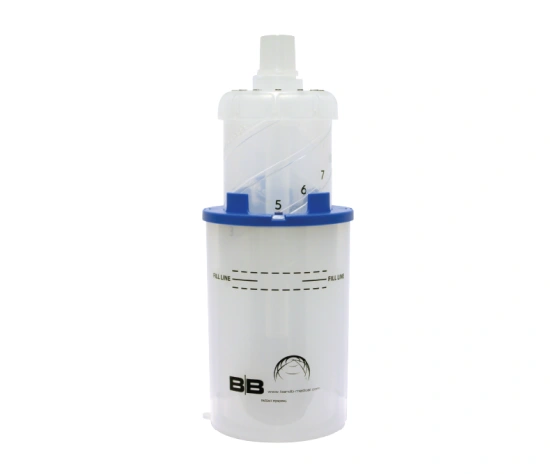
A course lasting weeks places steady demands on the circuit. The inspiratory limb delivers heated, humidified gas to the baby, and the expiratory limb sits in water at a depth that sets the pressure, with each centimeter of depth producing one centimeter of water pressure. Warming and humidifying the gas supports airway moisture during long stretches of therapy, and the details are covered in How does heated and humidified air improve CPAP therapy?
Pressure safeguards deserve equal attention, since a blocked circuit can raise the pressure the baby receives. A pressure-relief manifold is a component designed to limit pressure in the circuit, and its purpose is covered in What is the purpose of the pressure-relief manifold in Bubble CPAP?
How Parents Can Support a Baby Through CPAP Weaning
Parents can take several concrete steps during a weaning attempt, and each one gives the care team useful context.
- Ask which readiness criteria the unit uses and what corrected-age target applies to the baby.
- Ask for the current pressure and oxygen settings and how they have changed over the past week.
- Request skin-to-skin time when the nursing team approves it for the baby’s stability.
- Mention any redness or marks around the nose to the nurses, since nasal injury is a known risk of extended CPAP.
- Track feeding progress with the team, because a hospital study found that guideline-based CPAP weaning promoted oral feeding.
Coming off CPAP also changes the daily routine in the NICU, and the team can explain what to expect as the baby moves to high-flow support or room air.
Frequently Asked Questions
Most premature babies stay on CPAP for a few weeks, and studies report medians from about two weeks to a month or more. Babies born before 30 weeks often continue until 32 to 34 weeks of corrected age.
Many units aim for 32 to 34 weeks of corrected age in babies born before 30 weeks. Babies born later usually begin weaning sooner, once they have stayed stable on 5 cm H2O and room air for at least 48 hours.
The team restarts CPAP and waits for the baby to stabilize. Protocols allow another attempt after at least 24 hours once stability criteria are met again.
Some babies move directly to room air, while others step down to a heated, humidified high-flow nasal cannula first. The choice depends on the unit’s protocol and how well the baby tolerates each stage.
A hospital quality improvement study found that guideline-based CPAP weaning improved weaning success and promoted oral feeding in preterm infants. Feeding readiness still depends on the baby’s maturity and the team’s assessment.
B&B Medical Technologies: Neonatal Respiratory Components for Extended CPAP Care
B&B Medical Technologies has developed critical care airway devices since 1985, and its neonatal line covers the full bubble CPAP setup: the B&B Bubbler, Pressure Relief Manifold, Single Pole Clamp, NEO2-Safe, and nCPAP Cap. Baby Tape Plus secures endotracheal tubes on infants with a hydrocolloid adhesive formulated for neonatal skin, and endotracheal tube holders, including ET Tape II, ET Tape, StabilTube, and LockTite cover securement across patient sizes. The HOPE Nebulizer delivers continuous aerosol therapy, TrachGuard and TrachStay stabilize tracheostomy tubes, and the Universal Bite Block and Bite Proof Bite Block protect airway devices during intubation. A closer look at the company’s neonatal focus appears in CPAP for Newborns: Exploring B&B Medical’s Expertise.